the wild woman within (and how to meet her)

Melanie Chavez • June 10, 2026

remembering the part of you that was never meant to be tamed

There is a woman who lives inside of you. She has always been there. She was there when you were a little girl running barefoot, hair tangled, laughing at the top of your lungs without a single thought of who was watching. She was there when you danced in your bedroom with the door closed. She was there when you made decisions from your gut and trusted them completely. She was there before the world started telling you to be quieter, smaller, sweeter, more polished, less. She has never left.


She is the wild woman within. And she is patiently, quietly, fiercely waiting for you to remember her.


Most of us lost touch with her somewhere along the way. It happened slowly. A comment about how we were too loud. A look that said we were too much. A lesson that taught us being agreeable was safer than being honest. A culture that rewarded us for being palatable and punished us for being powerful. We learned to soften our edges, dim our intuition, swallow our knowing. We traded the wild for the acceptable.


And then, one day, we wake up. Maybe in our thirties. Maybe in our forties. Maybe, like me, not until our fifties. I didn't discover my wild woman until I was in my 50s, and I am living the truth of that right now, at 54 years old, in what feels like a true rebirth. This decade of my life has been unlike any that came before it. The layers I spent fifty years collecting have started to fall away. The voice I had quieted my whole life has gotten louder, clearer, more sure of herself. I am meeting parts of me I did not even know were waiting. And I want you to know: it is never too late. Not in your thirties. Not in your forties. Not in your fifties or sixties or beyond. The wild woman within does not have an expiration date. She has been waiting all this time, and she will keep waiting until you are ready. We wake up and feel a stirring. A restlessness. A sense that something is missing, even when our lives look perfectly fine on the outside. That stirring is her. That restlessness is her. That whisper is her, asking, do you remember me yet?


The wild woman is not wild in the way the word has been used against us. She is not chaotic, reckless, or out of control. She is wild in the original sense — untamed, undomesticated, free. She is the part of you that knows, deep in her bones, who you are and what you came here for. She is your intuition. Your instinct. Your truth. She is the version of you that does not perform for approval, does not shrink to make others comfortable, does not betray herself to keep the peace.


She is the woman who speaks up when something feels wrong. Who follows the call even when it doesn't make sense to anyone else. Who feels everything deeply and is not afraid of her own depth. Who knows the cycles of her body and honors them. Who understands that her sensitivity is a strength, not a weakness. Who trusts what she feels even when no one else can see it.


She is the woman the world has been trying to convince you not to be. And she is the woman you have been longing to come home to.


Meeting her is not about becoming someone new. It is about remembering someone you have always been. She has not gone anywhere. She has just been waiting beneath the layers of conditioning, the years of should, the lifetime of trying to be good. Meeting her begins with simply noticing where she has been suppressed — and gently inviting her back.


A few ways to begin meeting the wild woman within:


Listen for her voice. She is the quiet knowing underneath the loud thinking. She is the gut feeling you have been talked out of trusting. She is the no you swallowed and the yes you didn't say out loud. Start paying attention. Her voice has been there all along.


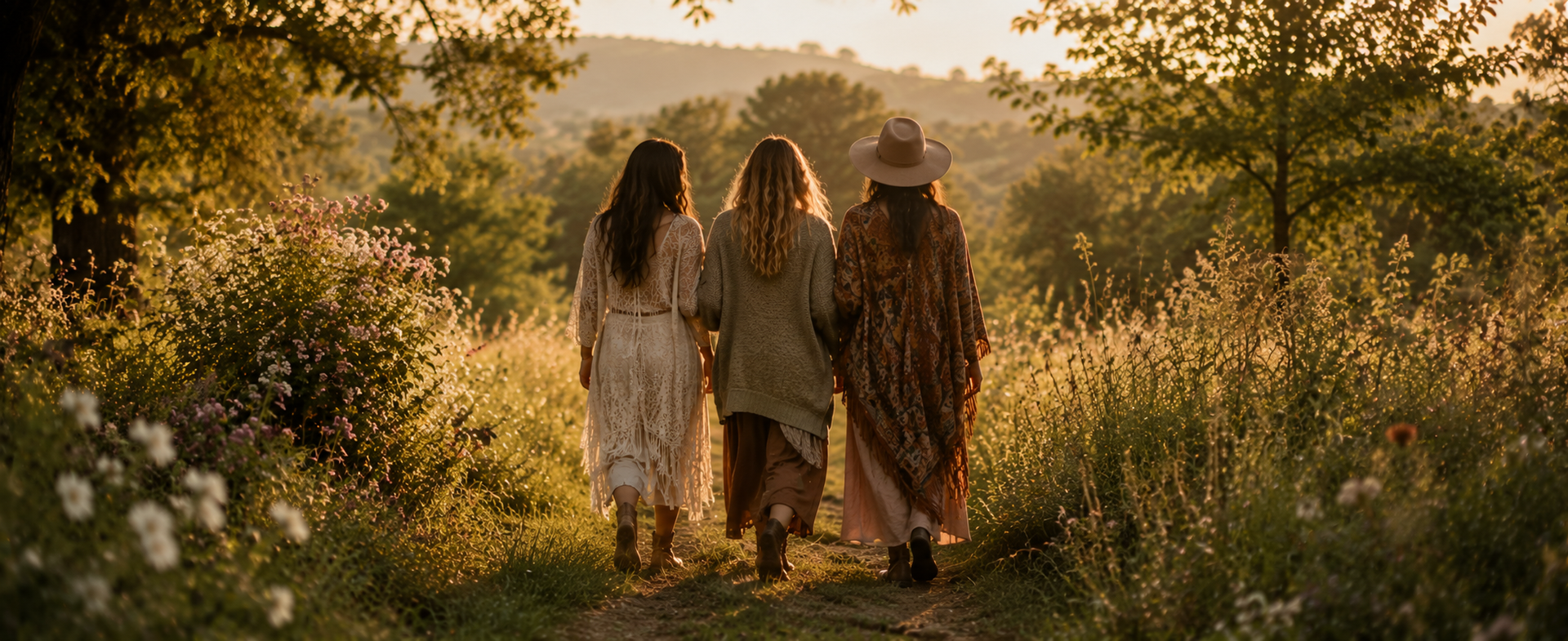
Spend time alone, in nature. She lives close to the earth. Walk in the woods. Sit by water. Lie on the grass. Take off your shoes. Let your body remember that you are part of the natural world, not separate from it. She often shows up in the wild places.


Move your body in ways that feel free. Not exercise for the sake of how you look. Movement for the sake of how it feels. Dance in your kitchen. Stretch on the floor. Sway. Shake. Let your body lead. The wild woman lives in the body, not the mind.


Honor your cycles. Pay attention to the rhythms of your body, the moon, the seasons. The wild woman knows that you are not meant to be the same every day. She understands rest as sacred, retreat as necessary, and slowness as wisdom. She does not push through.


Tell the truth. Even small truths. Especially uncomfortable truths. Every time you say what is real instead of what is expected, you call her closer. Every time you stop performing and start being, she stirs awake.


Stop apologizing for who you are. For your sensitivity. For your intensity. For how much you feel. For taking up space. For wanting what you want. For being too much, or not enough, or whatever the world has tried to make you believe about yourself. She does not apologize for her existence. Neither should you.


Trust your intuition again. Even when it doesn't make sense. Even when others can't see what you see. Your knowing is not crazy. It is ancient. It has kept women alive for thousands of years. Listen to it.


Gather with other women. The wild woman in you is awakened by the wild woman in others. There is something that happens in a circle of women that cannot happen anywhere else. You remember her in their presence. You give each other permission to come home.


Meeting her is not always easy. She will ask things of you that the domesticated version of you has avoided. She will ask you to speak up when you have always stayed quiet. To leave what is no longer yours to carry. To set down the masks. To let yourself want what you want without justification. She will ask you to become who you actually are, instead of who you have been pretending to be.


But she will also give you back to yourself. And that is the most precious gift there is.


The wild woman within is not someone you have to become. She is someone you have to remember. She is the truest version of you, the one underneath all the layers, the one who has been waiting patiently beneath the noise. She is your birthright. Your inheritance. Your soul.


She is calling you home.


Listen for her. Walk toward her. Let yourself remember.


She has been waiting for you all along.

By Melanie Chavez August 25, 2026
I’ve been thinking about babies lately. Not for the reasons you might think, but because they’ve helped me understand something about being human. Babies experience discomfort. They get hungry. They get cold. They get tired. Their bellies hurt. They want to be held. And when they’re uncomfortable, they let you know it—loudly. But a baby doesn’t lie awake thinking: Why does this always happen to me? What if this never gets better? What if something is wrong with me? Why can everyone else handle this when I can’t? What if I’m always going to feel this way? They experience the discomfort. We experience the discomfort and then tell ourselves a story about it. And I think somewhere in that space between what is happening and the story we create about what is happening, discomfort can become suffering. Discomfort and Suffering Are Not the Same Thing This distinction has been explored in Buddhist philosophy for thousands of years. Buddhism doesn’t teach that we’re somehow supposed to avoid pain. Quite the opposite. Life contains pain. Bodies hurt. People die. Relationships end. People disappoint us. We lose things we love. We don’t always get what we want. We age. We get sick. Things change when we desperately want them to remain the same. That’s part of being alive. There is a well-known saying that captures an idea often associated with Buddhist philosophy: “Pain is inevitable. Suffering is optional.” I think that can sound almost harsh when you first hear it. Because if you’ve experienced heartbreak, grief, trauma, illness, betrayal, or loss, suffering certainly doesn’t feel optional. And I don’t think the point is that we can simply decide not to hurt. Pain is part of the human experience. Buddhist philosophy doesn’t ask us to pretend otherwise. In fact, the recognition of dukkha—often translated as suffering, dissatisfaction, or unease—is at the very heart of Buddhist teaching. Life changes. We lose people. Bodies age. Relationships change. Things don’t always go according to plan. We experience things we don’t want, and we lose things we desperately want to keep. That’s the pain of being human. But Buddhist philosophy also asks us to look at what happens after the pain arrives. We resist it. We cling to what we wish were happening instead. We desperately want reality to be different from what it is. We replay what happened. We predict what will happen next. We judge ourselves for feeling the way we feel. We attach stories to the experience: This shouldn’t be happening. I can’t handle this. I’ll never be okay again. Why does this always happen to me? Something must be wrong with me. And now we’re no longer experiencing only the original pain. We’re experiencing the pain plus everything our mind has built around it. What Does “Suffering Is Optional” Really Mean? Pain is inevitable. We are human. We are going to experience loss, heartbreak, disappointment, illness, fear, grief, change, and moments that simply hurt. We cannot control everything that happens to us, and no amount of healing or spiritual growth will give us a life completely free from pain. But suffering? That’s where things get more complicated. Maybe optional doesn’t mean we consciously choose whether or not to suffer. Most of us aren’t consciously choosing it at all. Maybe it means that some of our suffering is created subconsciously through our resistance, attachment, fear, judgment, and the stories we continue telling ourselves about what happened. And if some of our suffering is created there, then perhaps some of it can also be released there. There is another Buddhist teaching that illustrates this beautifully: the two arrows. The first arrow is the pain life gives us. The second arrow is the suffering we add ourselves. And I keep thinking about that. Because I shoot myself with the second arrow all the time. I think most of us do. We Don’t Consciously Choose Suffering I want to be really clear about this. When I say that we sometimes participate in our own suffering, I don’t mean that someone wakes up in the morning and thinks: You know what sounds great today? Misery. And I certainly don’t mean that someone caused their trauma, abuse, illness, loss, or whatever painful thing happened to them. That’s not what I’m talking about. I’m talking about the subconscious ways we participate in our own suffering after something painful happens. Someone says something hurtful to me. That’s the first arrow. Then I replay the conversation for three days. I imagine what I should have said. I wonder what they think about me. I tell myself they don’t respect me. Then I remember another time they hurt me. Then another. Then I imagine what they’ll say the next time I see them. The original conversation lasted five minutes. I’ve now lived it for three days. That’s the second arrow. And I know that pattern because I’ve lived it—repeatedly. Sometimes Suffering Sounds Like Resistance This shouldn’t be happening. They shouldn’t have done that. I shouldn’t feel this way. My life should look different by now. Sometimes it sounds like fear: What if this never changes? Sometimes it sounds like shame: Why am I like this? Sometimes it sounds like comparison: Everyone else seems to have figured this out. Sometimes it sounds like attachment: I cannot be okay unless this person stays. I cannot be happy unless I have this amount of money. I cannot feel successful unless my life looks this particular way. And sometimes suffering looks like trying desperately to control something that was never ours to control. The discomfort may be real. The grief may be real. The fear may be real. The heartbreak may be very, very real. But then the human mind gets involved. And we can turn one painful moment into a thousand painful moments. This Doesn’t Mean We Should Stop Feeling Actually, I think it’s the opposite. Avoiding discomfort can create its own kind of suffering. We numb. We distract ourselves. We stay busy. We scroll. We overwork. We overthink. We pretend we’re fine. We spiritually bypass what hurts by trying to turn everything into a lesson before we’ve even allowed ourselves to feel it. But maybe the answer isn’t escaping discomfort. Maybe it’s learning how to experience discomfort without immediately building a home inside it. Feel the sadness. Feel the anger. Feel the disappointment. Feel the fear. Let your body experience what is actually here. Then notice what your mind begins adding. That’s the practice I’m becoming interested in. Not: How do I make sure nothing uncomfortable ever happens to me? Because that’s impossible. But: How do I stop turning every uncomfortable experience into a story about who I am, what my life means, or what will happen next? That’s different. Maybe Babies Know Something We’ve Forgotten A baby can be absolutely devastated because they’re hungry. Then you feed them. And five minutes later, they’re staring at the ceiling fan like it’s the greatest thing humanity has ever invented. There’s something beautiful about that. The discomfort came. They experienced it fully. Their need was met. And the moment passed. They haven’t learned to carry yesterday into today yet. We have. Obviously, adult life is infinitely more complicated than a baby’s hunger. Some experiences leave real wounds. Trauma can change the nervous system. Grief doesn’t disappear because we decide to “let it go.” There are experiences that take years to process. There are things we may carry with us for the rest of our lives. But carrying something isn’t necessarily the same thing as suffering inside of it forever. And I still wonder if there’s something we can learn from the distinction. Pain asks to be felt. Suffering often asks to be believed. Maybe that’s part of healing: learning to recognize the difference. Learning to ask: What is actually happening right now? And then: What am I adding to it? Because perhaps freedom isn’t a life without discomfort. Maybe freedom is learning that discomfort can move through us without becoming the story of our lives. The first arrow may not always be ours to choose. But maybe, with awareness and practice, we can slowly learn to stop firing the second one. And maybe that’s what “suffering is optional” is really asking us to consider.
By Melanie Chavez August 10, 2026
how we learn to disconnect from ourselves — and what healing might really mean
By Melanie Chavez August 10, 2026
the gentle practice of caring less about everything else so you can care more about you
By Melanie Chavez July 26, 2026
why we postpone happiness in the hopes of more later.
By Melanie Chavez July 26, 2026
the real reasons doing less is doing more
By Melanie Chavez July 7, 2026
there is a particular kind of grief that comes from watching the land you love turn to smoke. for over a week now, our foothills have been burning. the Aspen Acres fire has moved through precious communities — places that have felt safe to us. they are where we hiked, where we knew the shape of the ridgeline against the sky, where some of us built our whole lives. thousands of our neighbors have been evacuated. many still don't know if their homes are standing. some already know they are not. if you are reading this from inside that experience, or from just outside it watching people you love go through it, i want to say the thing that trauma work has taught me above almost everything else: there is no wrong way to be feeling right now. numbness is not weakness. tears are not an overreaction. rage at the sky is not dramatic. your nervous system is doing exactly what it was built to do when the ground itself stops feeling safe. for those of you living it directly if you evacuated, if you're waiting for word on your house, if you've already lost it — your body has been in survival mode for days, maybe longer than you've let yourself notice. that matters more than it might seem. the nervous system doesn't clock the difference between "the fire is still burning six miles away" and "the fire is in my living room." it just knows danger, and it stays braced for it. so the first thing i want to offer you isn't advice. it's permission. permission to not be okay yet. permission to feel oddly calm one hour and shattered the next — that's not you failing to cope, that's what regulation actually looks like when the threat isn't fully over. permission to grieve things that feel "smaller" than a house — a garden, a view, the quiet of a place, a version of normal you can't get back to yet. a few things that can genuinely help while your body is still in this state, not as a fix but as an anchor: your breath is one of the only parts of your nervous system you can reach directly. when you notice your chest is tight or your thoughts are racing, try making your exhale longer than your inhale — in for four, out for six or seven. this isn't about calming down on command. it's about giving your body evidence, slowly, that it's allowed to come down out of the high alert it's been living in. let your hands do something. fold laundry, dig in dirt, hold a warm mug, press your palms flat against a table. trauma lives in the body, and the body often finds its way back before the mind does. you don't have to think your way out of this. you can feel your way out of it too. be careful with the news cycle and the acreage updates. staying informed matters, but there's a difference between checking in and marinating. give yourself windows where you put it down, even for twenty minutes. and please, let people help you. i know how hard that is for those of us who are used to being the strong ones, the ones who hold space for everyone else. this is not the week to prove you don't need anything. accepting a meal, a couch, a hand with paperwork — that is not weakness. that is community doing what it's for. for those of you holding space for someone else maybe your home is fine and someone you love's isn't. maybe you're a practitioner, a neighbor, a friend who wants to help and doesn't know how, or worries anything you say will land wrong. i see you too, and i want to gently say — you are allowed to be affected by this even if you didn't lose anything. holding space for grief you're not the center of is its own kind of weight, and it's real. when you're supporting someone who is displaced or grieving a home, the most healing thing you can offer usually isn't a solution. it's your steadiness. you don't need the right words. you need to be a nervous system that isn't in crisis, sitting next to one that is — because our bodies borrow calm from each other. that's not a metaphor, it's physiology. your presence alone is doing work. resist the urge to rush them toward silver linings. "at least everyone's safe" is true and it can still land as dismissive when someone is standing in the ash of their kitchen. let people be devastated in front of you without trying to fix the devastation. ask what they need instead of guessing — sometimes it's practical, sometimes it's just someone to sit with them while they don't talk at all. and take care of your own capacity. you cannot pour from a nervous system that's also running on empty. it's okay to help and also need to step away and refill. what tragedy also reveals there is something else true alongside the grief, and it deserves its own space here, because it's part of the healing too. tragedy has a way of showing us exactly who we are as a community, and this week it's shown us something beautiful. people who lost almost everything have still shown up to help set up donation centers for their neighbors. volunteers who have no personal stake in these mountains have been driving in from surrounding towns just to serve meals and set up water slides for evacuated kids, because a child deserves a moment of joy even in the middle of losing their home. strangers have opened their homes, their trucks, their wallets, their weekends. shelters filled almost as fast as the evacuation orders went out. this is what happens when a community remembers it's a community — not because the danger disappears, but because no one has to face it alone. this is the part of trauma that doesn't get talked about enough: it isn't only rupture. it can also be the thing that softens the walls between us. the person who wouldn't normally ask for help learns to receive it. the person who's never volunteered a day in their life shows up with a truck bed full of water bottles. we are reminded, sometimes at great cost, how much we actually need each other — and how willing we are to show up when it counts. that thread of connection is its own kind of medicine. it won't undo what's been lost. but it is proof, in real time, that this community knows how to hold itself together even while it's breaking. a word on collective grief this fire isn't just individual loss stacked eleven thousand times over. it's a collective wound. our community is going to be metabolizing this together for a long time — longer than the containment percentage will suggest, longer than the news will stay interested. healing from something like this isn't linear and it isn't quick, and it doesn't happen alone. it happens in kitchens and donation centers and circles like the ones we hold at the studio, in the small acts of people showing up for each other again and again. if you need a place to simply be with what you're carrying — not to perform okay-ness, not to have it fixed, just to be held in it — our doors are open. whatever you're feeling this week, it belongs here. we will rebuild what can be rebuilt. and what can't be rebuilt, we will grieve together, for as long as it takes.
By Melanie Chavez July 2, 2026
the soul-deep connection your heart has been quietly waiting for
By Melanie Chavez June 30, 2026
remembering what this practice was always meant to be
By Melanie Chavez June 18, 2026
the quiet truth that we were never meant to do this alone
By Melanie Chavez June 10, 2026
why your tears are not a weakness, but a doorway to healing